The Fabric of Time
A journey through the cosmos
Matthew Ward-Broadfield
2026
How this started.
Come on, let me take you on a journey, a journey through the cosmos where space is the fabric of time.
Before we go, I want to tell you how I got here, because it shapes everything that follows.
It started with a problem I could not let go of.
When Isaac Newton wrote down his theory of gravity in the sixteen hundreds, he gave the world an answer that seemed final. Every mass attracts every other mass with a force that depends on the two masses and the distance between them. With that one law, Newton explained the orbits of the planets, the motion of the Moon, the tides, the falling of an apple. For two hundred years his theory was the foundation of physics, tested against everything we could measure, and it worked.
Then it cracked. Mercury, the innermost planet, has an orbit that slowly rotates around the Sun. Newton's law, applied carefully to the other planets pulling on Mercury, predicted some of that rotation but not all of it. There was a small leftover Newtons equation could not explain (Newton Passed away in 1727. French astronomer and mathematician Urbain Le Verrier first discovered that Mercury's orbit did not perfectly fit Newton's equations. In 1859). People in the eighteen hundreds were so sure Newton was right that they invented a new planet to fix it. They called it Vulcan. They believed it was hiding very close to the Sun, too small to see, providing the extra tug. They looked for Vulcan for decades. It was not there.
Newton himself, by the way, was honest about a deeper issue underneath. He gave us the law that mass attracts mass, but he never said how. He called it action at a distance and admitted he did not know what was actually doing it. Isaac Newton did not know about Mercury's orbital anomaly because the telescope technology of his time was not precise enough to detect it, and the math required to isolate the tiny discrepancy had not yet been developed. The Discrepancy is Microscopic: The unexplained shift in Mercury's orbit is incredibly tiny—just 43 arcseconds per century. To put that into perspective, 43 arcseconds is roughly the width of a human hair viewed from 30 feet away. It takes 300 years for this error to add up to just the diameter of the full Moon. Newton didn't get it wrong as his equation is the heart of mine, he just did not have the data to add to it.
Albert Einstein, three hundred years later, gave the world a new answer. Gravity, he said, is not a force at all. It is the curvature of spacetime. Mass bends the four-dimensional structure of space and time, and other things move along the curved geometry. With that picture Einstein recovered Newton's law as the everyday limit, and he got Mercury's small leftover exactly right. Forty-three arcseconds per century, the same as observation. He explained the bending of light by the Sun. He predicted the slowing of clocks in gravity, the existence of gravitational waves, the way black holes form. All confirmed. All beautiful.
But Einstein has a problem too, and the problem is galaxies. When astronomers measure how fast the outer stars of a galaxy are rotating, they find the stars are moving too fast for the visible matter to hold them in place. Einstein's theory, applied to galaxies, gives the wrong answer. So we invented dark matter. Five times more invisible material than visible, hiding in the outer halos of every galaxy, providing the extra pull. Fifty years of laboratory experiments, some of them buried more than a kilometre underground, have searched for dark matter particles. They have found nothing. Dark matter is the modern Vulcan.
So that is what bothered me. Two of the greatest theories in the history of physics, both successful in their proper domains, both running into trouble at specific scales, both being patched with invisible substances that nobody can find. And the patches keep not working.
Then I noticed something. Newton was right about one thing in particular. Mass causes gravity. That much is correct beyond reasonable doubt. The Earth pulls things down. The Sun holds the planets in orbit. Where there is mass, gravity follows. Both Newton and Einstein were both right in their domains and both were hindered by technology/data. Newton as you know above and Einstein did not have the Galaxy data we have today. He finished GR in 1915. Andromeda was first discovered in 1923.
So I asked myself: what if mass really does cause gravity, like Newton said, but the way it does it is something neither of them got to? What if we have been wrong about the most basic assumption of all, the assumption that space is empty?
We do not live in a four-dimensional vacuum. Space cannot be empty. There has to be something there, a medium, that mass acts on and that does the work of gravity. Without a medium you have action at a distance and no answer to Newton's question. With a medium, mass compresses what surrounds it, and the compression is what we have been calling gravity.
Where the medium is denser, time runs slower — that is what gravitational time dilation is. The medium is what time itself is made of. Matter congests it. Where it is congested, everything happens more slowly. That is the whole picture in one sentence. Space is the fabric of time, and matter congests it.
From there it took 32 days from the first equation below to the paper in the menu. I gave the local density of the fabric a name and a single letter — n, the congestion index. I worked out the six numbers (it started with 3, then 4 and then from querying other numbers, realised they are part of how the medium works) , the fabric's own moduli, that describe how it behaves: how it resists being shaken, how it resists being bent, where its preferred resting density sits, how slowly it relaxes back, where its stiffness changes regime, how strongly it self-sources in galactic halos. To couple matter to it I needed four more numbers, the coupling constants, including Newton's gravitational constant and Planck's quantum constant. Ten numbers in total. Each anchored to a separate observation. None adjustable. This is very similar to how Newton made Calculus, he put together different fields in Maths, I have put together different fields in the Universe.
Then I wrote down the equation. One equation that tells you, given the local matter and the state of the fabric everywhere else, how the fabric responds. I called it the Master PDE. My goal was to work on Einstein's Dark Matter problems which yielded the Ward Constant. Newton's gravity in the everyday regime. Einstein's results in the strong-field regime. The flat rotation curves of galaxies, without dark matter. The accelerating expansion of the universe, without dark energy. I kept pushing to see where it could go and it started to fit Quantum Mechanics too. The proton's mass divided by the electron's, from the integer windings of closed-loop matter. The Born rule of quantum mechanics, from the intensity of fabric vibrations. Black holes finite throughout. The Big Bang replaced with a Big Rebound from the fabric's maximum compression. About one hundred and forty new predictions, of which around forty are sharp enough to be falsified by a single experiment.
One field. One equation. Ten numbers. Everything else derived. Temporal Congestion Mechanics — TCM. That is what we are going to walk through.
Now let me show you the cosmos.
The Big Rebound - The Start of the Universe.
We are starting at the beginning. The very beginning. And the very beginning is not what you have been told.
You have probably heard the standard story. About fourteen billion years ago, the entire universe was concentrated in a single point of infinite density. The point exploded — the Big Bang — and space has been expanding ever since. The expansion gave us galaxies, stars, atoms, us.
Most of that is right. The universe is expanding. There was an early hot phase. Atoms and stars and galaxies came later. But the very first moment — the singular point of infinite density — is not real. It is what happens when you take Einstein's equations and run them backwards in time without anything to stop them. The equations give you infinity. Infinity is not a physical answer. It is a sign the equations have run out of road.
Think about it for a second. Infinite density means no size. No volume. Just a mathematical point. Does that sound like a place you can be? It is not. The Big Bang singularity has always been a placeholder for our ignorance about that very first moment.
Here is what actually happened. The fabric of space has a maximum density it can hold. It is a property of the medium, like the breaking point of a rope or the stiffness of steel. Push the fabric harder than this maximum and it pushes back, infinitely hard. The fabric refuses. There is a wall.
And the wall, when you work out where it is, comes out as a beautiful number. How I got there was just by chance, My new Theory is giving me numbers the world has never seen. The Sun's congestion index number is 1.000002122. Resting Space is 1.0 so the Sun makes a little dent. Earth is even smaller 1.0000000007. Our Black Hole Sgr A* though is 1.648721. So I wondered what is the super huge Black Hole Ton 618's index number, considering it is 15,887 times bigger. You would assume it is going to get bigger, similar to how Planets, Stars and Black Holes do. But.......It came out as 1.648721 the same!! Which, although a shock, it meant I had found another universal constant, Space has a maximum limit it can be congested, Black Holes just simply get bigger. A frozen lake is no different to an ice cube in how it freezes, it is just bigger. Now listen to this, Multiply that number by itself and you get the mathematical constant e!! Exactly e, which has been around since Newton (First noticed by Jacob Bernoulli 1683, named by Leonhard Eular, 1731) but don't confuse the start of the universe with a black hole, they simply share the same maximum the fabric allows.
So picture this. The universe begins not at a point of infinity but at a wall of maximum compression. The fabric is everywhere at the Broadfield Constant. Saturated. Squeezed as far as it can go, in every direction. And the fabric does not like being there. It is full of stored elastic pressure pushing outward, like a compressed spring that has been held down for too long.
Then it lets go. Negative Pressure.
All at once, everywhere. The fabric rebounds. Space opens up — not into anything, because there is no "into," space is what the fabric does — but the fabric eases below maximum and there is suddenly room. Lots of room. Expanding fast.
And here is something nobody tells you about the early universe. The expansion was furiously fast at the start. The fabric relaxing from saturation, releasing all that stored elastic pressure, opening up in every direction at once. Then it began to slow. As the fabric relaxed, the pressure dropped. The expansion eased. It is still going on today, fourteen billion years later — the universe is still expanding, the fabric is still relaxing — but it is slower now, and still slowing toward its preferred resting state. We will come back to this when we get out to the universe at large.
There was no explosion. There was no bang. The Big Bang is the wrong picture entirely. There was a fabric at maximum compression, and it relaxed. Tremendous, yes. But not violent in the bang sense. Just an enormous medium, quietly letting go.
Now, you might be wondering. If the fabric was already at maximum compression at the start, what was it doing before? What put it there?
I want to be honest with you. I do not know. I am not sure anyone can know. My honest answer is this. Time has always been. Time is what the fabric does. Asking what came before time is like asking what is north of the North Pole. Once you are at the pole, there is no more north. Once you have stripped time away, there is no more before or after.
That is the most honest thing I can tell you. And it is a much better answer than infinity-at-a-point, because at least it is easier to comprehend. Time has always been around.
Now let me show you what happens next.
How matter formed.
Watch closely. The fabric is dropping below its maximum density now, and that means something new becomes possible. The fabric can vibrate.
It could not before. At maximum density, no local variations were allowed — there was nowhere for them to go. But now, with the fabric easing back, it can ripple. And the first thing that happens, before anything else, is light.
Light is a fabric vibration. That is what light is. A photon is not a tiny ball flying through empty space; it is the fabric itself, wobbling, propagating its wobble outward. The first thing to fill the new universe was light. The fabric had relaxed enough to wobble, and it did.
Now think of it like water. Water can be ice, or it can be liquid, or it can be steam. Same H₂O molecules, three different configurations of the same stuff. The fabric is like that. It can sit at rest, doing nothing — that is empty space. It can ripple, and that is light. It can twist itself into knots, and that is matter. It can be squeezed to maximum density, and that is what is at the heart of every black hole. Same substance. Different configurations. That is the whole universe.
The knots are the part I want you to picture next. The fabric, where it has been twisted into a closed loop and locked in place by its own topology, behaves as a particle. The knot stores energy. That energy is the particle's mass. The way the knot is wound — how many times around itself, in what direction, with what internal twist — determines what particle it is. A knot. That is all a particle is.
Different knots are different particles. The lightest stable knot is the electron. A more complicated knot, with more windings, is the proton. Different patterns again give the muon, the tau, the neutron, and the rest of the catalogue. Each pattern in the catalogue is a specific way the fabric can knot itself stably.
And here is what makes it land. Every knot's mass falls out of the integers in its winding. Whole numbers. The proton's mass divided by the electron's mass, for example, comes out as sixteen times one hundred and fifteen — eighteen-forty. The actual measured ratio is eighteen-thirty-six. It is not a fit. It is integer arithmetic, falling straight out of the topology. The tau, a heavy cousin of the electron, gives thirty times one hundred and fifteen — thirty-four-fifty, against the measured thirty-four seventy-seven. Same arithmetic. Whole numbers from the way the fabric knots.
All the rest of the strangeness of matter falls into place once you see this. Why are electric charges always whole numbers? Because the topology of a closed loop demands it — the loop's internal phase has to come back to where it started after one journey around, which forces integer winding, which is the charge. Why are there no isolated quarks with charges of one-third? Because no closed-loop topology can support a fractional charge in isolation. The quarks are sub-windings inside larger knots — protons and neutrons — and they cannot exist outside them. That is why fifty years of trying to free a quark have produced no isolated quark.
Why is matter exclusive — why can't two electrons sit in the same quantum state? Topology again. Why does antimatter exist? Because every knotting pattern admits a sign-paired version with the windings reversed. Why do they have the same mass to thirteen decimal places? Because the action that gives them mass cannot tell the difference. All of it from one substance, knotted in different ways.
So as the fabric relaxed after the rebound, the lightest knots became possible first. Electrons. Protons. Then heavier patterns as conditions allowed. Then atoms — electrons binding to nuclei. And once atoms had formed, the universe went transparent. The light that had been bouncing around between charged particles was suddenly free, and it streamed outward. Some of that light is still travelling now. We can detect it across the whole sky. It is the oldest light there is. Every direction you look, it is there — relic light from the moment the fabric eased enough that atoms could exist.
The fabric let go. It rippled and gave us light. It twisted itself into knots and gave us matter. From one substance, doing two things, came everything you can see.
Stars and the structure that follows.
Now keep walking. Atoms have formed. The universe is full of hydrogen and helium — the lightest atoms, the ones the fabric made first. And they are not perfectly evenly spread. Tiny ripples in the fabric from the rebound mean some places have a little more matter than others.
Watch what happens. A region with slightly more matter has slightly more compressed fabric around it. Slightly more compressed fabric pulls in more matter from nearby. More matter means more compression. More compression pulls in more matter. The denser regions grow. The thinner regions empty out. Over millions of years, the universe organises itself.
At some point, in one of those denser regions, gravity squeezes the gas hard enough that the centre lights up. Hydrogen begins to fuse into helium, releasing energy. A star is born. The first stars were enormous, thousands of times the Sun's mass, and they burned through their fuel in a few million years. When they ran out, they did not just go dark. They exploded. And in those explosions they forged heavier elements — carbon, oxygen, iron — and scattered them out into the surrounding fabric.
This part matters more than you might think. Every atom of carbon in your body, every atom of oxygen in your next breath, every atom of iron in your blood, was made inside an ancient star and scattered into space when that star died. You are made of stardust. Literally. Not poetically — literally. The heavy elements that make up your body did not exist in the early universe. They had to be made, inside stars, and dispersed by stellar deaths, before you could happen.
Then those scattered elements gathered into new clouds. New clouds collapsed into new stars. Around some of those new stars, the leftover material clumped into planets. About four and a half billion years ago, in a quiet spiral arm of an ordinary galaxy, one such collapse made our Sun and the planets around it. The Earth is the third planet out. It is at exactly the distance from the Sun where water can exist as liquid — not too hot, not too cold. And here we are, made of stardust, reading about ourselves.
Our solar system.
Stop here for a moment. We are home. This is the place where humans first wrote down the laws of physics and the place where they first found that the laws were not quite complete. So let me show you what is actually going on.
In the solar system, the fabric is in what I will call its everyday regime. The fabric is very close to its resting density almost everywhere. At the Earth's surface the compression is one part in a billion. Near the Sun's surface it is a couple of parts in a million. Tiny. But enough to do everything we feel as gravity.
In this regime the fabric responds to mass in a smooth, almost-linear way. Twice the mass means twice the compression. The gravitational attraction comes out as Newton's inverse-square law, almost exactly. Newton's law is what the fabric does in the everyday regime. He was right about the solar system, almost everywhere.
Almost. Not entirely. Near the Sun, where the compression is largest, the fabric's behaviour goes very slightly beyond linear, and Mercury's orbit shows it. Mercury's perihelion drifts forward by a tiny leftover that pure Newtonian gravity cannot give you. Forty-three arcseconds per century. Work it out from the fabric's properties, and you get exactly that. Forty-two point nine eight. Not because we have imported Einstein's equations, but because the fabric, in this regime, behaves the way Einstein's equations describe.
Same with light bending around the Sun — works out exactly, one point seven five arcseconds at the solar limb. Same with the slowing of clocks in the Sun's gravity, and the slight extra time radio signals take to graze the Sun, and the precession of orbiting gyroscopes, and the dragging of the local fabric by rotating masses. All of it falls out of the fabric's response to the Sun's mass. Not a fudge factor in sight.
And there is one prediction in our solar system that nobody has measured yet, and it is one of the cleanest tests of the framework. The Sun spins, and a spinning mass drags the surrounding fabric with it — a little corkscrew effect. Einstein predicted it; satellite experiments have confirmed his number around the Earth. But our framework predicts a small extra shift on top of that, at the level of one part in ten thousand. We call it the Solar System Shield. With current instruments it is just below detection. With the next generation of precision satellites it should be findable. If the shift is there at one part in ten thousand, the framework is right. If not, the framework has a problem. That is the kind of clean test we should treasure — a number, a precision, an experiment that either confirms or refutes. We will know within a decade or so.
Galaxies.
Now leave the solar system and go out to a galaxy. This is where it gets really good.
Look out at the edge of a galaxy. The stars at the outer edge are a long way from the visible centre. There is not much matter pulling on them. By Newton's law, by Einstein's law, they should be moving slowly. The way Neptune moves slowly compared to Mercury, because Neptune is far from the Sun.
They are not moving slowly. They are moving fast. Same speed as the inner stars. The whole rotation curve goes flat instead of falling off the way it should. Every galaxy we have measured does this. Hundreds of them. The data is rock solid. This is the single most thoroughly established observation in modern astronomy that conventional physics cannot explain.
For fifty years, the answer has been: there must be invisible matter out there, five times as much invisible as visible, providing the extra pull. We call it dark matter. We have built giant detectors deep underground to find a single dark matter particle. We have searched at every conceivable mass and interaction strength. We have found absolutely nothing.
Ready for the truth?
There is no dark matter.
The fabric, out at the edge of a galaxy, is doing something different from what it does in the solar system. Think of it like this. A rubber band at low stretch behaves one way — easy to pull, soft response. Stretch it harder and the response stiffens. The fabric has the opposite-direction regime change, but the same idea: at very low gradients, very gentle pulls, the fabric's behaviour shifts. Instead of responding linearly to mass it becomes gradient-dependent. Self-sourcing. Out in the galactic halo, where the pull is below a certain threshold, the fabric generates its own outward pull on top of the pull from the visible matter. That extra pull is what keeps the outer stars moving fast. Not invisible particles. The fabric, in a different regime.
And here is the part that, when I worked it out, made me sit back. There is a famous law of galaxies — the baryonic Tully-Fisher relation. It says the fourth power of the flat rotation speed equals Newton's constant times the visible mass times a fundamental threshold. The slope is exactly four. Not three point eight, not four point two. Four. And this slope of four falls out of the fabric's behaviour in the new regime, with no fitted parameters. The relation is exact. The structure forces it.
There is more. Every galaxy approaches the same outer rotation speed at very large radius. About one hundred and forty-nine point six seven kilometres per second. Light galaxies approach it from below, rising toward it. Heavy galaxies approach it from above, declining toward it. Both meet at the same number. Every spiral galaxy in the universe converges to it. We call it the Ward Constant, and it falls out of three of the fabric's basic properties — the speed of light, Newton's gravitational constant, and the fabric's gain factor — with no other input.
If galaxies do not converge to that number, the framework is wrong. Falsified. End of story. So far, the data is consistent. Hundreds of galaxies, observed over decades — they all approach the same asymptotic speed. The universe has a built-in galactic speed limit, and it is one hundred and forty-nine point six seven kilometres per second.
This is what I mean when I say we now know how the universe works. It is not dark matter keeping the outer stars in orbit. It is the fabric itself, in a regime nobody had thought to look for, doing exactly what we observe. Fifty years of searching for an invisible particle. The answer was the medium itself, all along.
Now let me tell you something cool that follows from this — a prediction worth picturing. Galaxies merge. It happens all the time on cosmic timescales. Two galaxies pass too close, gravity grabs them, they spiral in, and over hundreds of millions of years they fuse into one bigger galaxy. The Milky Way and Andromeda will do this in about four billion years.
When two galaxies merge, the fabric in that whole region gets struck. Like a bell. And like a bell, it rings.
The ring has a frequency. The fabric's natural oscillation period is about six hundred million years — it is one of the basic numbers of the framework, set by the fabric's own properties. So after a major merger, the rotation curve of the new galaxy should oscillate slowly, slightly speeding up and slightly slowing down on a six-hundred-million-year cycle, like a struck bell ringing on through the centuries. Galaxies that have merged in the last few billion years should be ringing right now.
This is a forward prediction nobody has tested yet, but the data to test it is sitting in the archives — surveys like JWST and SDSS have observed thousands of post-merger galaxies. Someone with the right algorithms could pull that ringing out tomorrow. If it is there at six hundred million years — the predicted period of the fabric's natural oscillation — that is a beautiful confirmation. If it is not there, the framework has a problem.
A bell rings because it is elastic. The galaxy rings because the fabric is elastic. Same physics, different scale.
The universe at large.
Now zoom out further. Past the galaxies, past the clusters, out to the cosmic web — the network of dense filaments and vast empty voids that makes up the universe at the largest scales. And ask what the whole thing is doing.
It is expanding. We have known that for a hundred years. The galaxies are moving apart. The further away, the faster. And about thirty years ago, astronomers measured the expansion to enough precision that they discovered something shocking. The expansion is not slowing down. It is accelerating. Something is pushing space apart faster and faster, against gravity, and we cannot find what.
The placeholder name is dark energy. By current measurements it is seventy percent of the universe's energy content. Add dark matter on top of that and the dark sector is ninety-five percent. Stop and let that sink in. The standard cosmology says ninety-five percent of the universe is made of substances we have never detected. That is not a small embarrassment. That is the universe, almost entirely, hidden from us. If you were a scientist, would you accept that? I would not.
Dark energy is not a substance. It is the fabric, finishing what it started at the rebound.
Remember. The universe began at maximum compression. The fabric has been relaxing ever since. In dense regions — galaxies, clusters, places where matter holds the fabric in place — the relaxation is suppressed. The fabric stays compressed. But out in the cosmic voids, where there is barely any matter for billions of cubic light-years, there is nothing holding the fabric. So it relaxes. As it relaxes, it releases the elastic energy stored at the rebound, and that release is outward pressure. That outward pressure is what we are seeing as accelerating expansion.
Think of a memory-foam mattress. You sit on it, and it compresses. Stand up, and it slowly returns to shape. The fabric is doing that, only at cosmic scale and slowed down to billions of years. The voids of the universe are the parts of the mattress where nobody is sitting any more, and they are rising back to their resting shape. That rising is the cosmic acceleration. There is nothing mysterious about it. There is no dark energy substance. There is just the fabric, returning, in the regions empty enough to let it.
And here is something this means. The acceleration is not permanent. It is transient. As the fabric finishes relaxing, the pressure drops to zero and the acceleration fades. Eventually the universe will settle into a coasting expansion, and eventually slow further as the fabric reaches its preferred resting state. The bleak picture of an eternally accelerating universe ripping itself apart is wrong. We are heading to a much quieter long-term future than that — a slow coast toward the fabric's permanent rest.
There is a precise prediction the framework makes about the shape of the relaxation today. The current strength, expressed as a deviation from the simple cosmological-constant picture. The deviation peaked around five billion years ago and is now declining. Future precision cosmological surveys, sensitive at the part-per-thousand level, should detect it. If they do, the framework is right. If not, the framework has a problem. Two more clean tests, like the Solar System Shield and the galactic ringing — specific numbers, specific experiments, definite answers within reach.
The very small, Quantum World.
Remember Honey I Shrunk the Kids Film? Now turn around with me. We have gone from the rebound out to the universe at large. I want to take you down to the smallest scales and show you that it is the same fabric doing different things. And I want you to have fun with this part, because the famously weird quantum behaviour — the stuff every popular-science book tells you to just accept and not try to picture — actually makes sense once you know what is happening.
Here is the rule of the small world in TCM, in one sentence. The fabric vibrates and the fabric knots, and that is all there is.
Light is a fabric ripple. A photon is one quantum of that ripple — one elementary excitation of the medium. Matter is a fabric knot. Both are configurations of the same fabric. Already, in just that, you have wave-particle duality dissolved. Particles are not waves and particles, mysteriously both. They are knots in a vibrating medium. They have wave properties because the medium they live in is a wave-supporting medium. They have particle properties because they are localised knotted configurations. There was never a duality. There was just one substance doing different things at the same time.
Let me take you through the famous spooky problems, because the framework solves them.
The double-slit experiment. You fire a single electron at a screen with two slits in it. Somehow the electron seems to go through both slits at once and produce an interference pattern on the far side. Spooky? Not in TCM. The electron is a fabric configuration, and the fabric extends. A fabric ripple does not have a definite location — it is spread out, like any wave. So when the ripple reaches the slits, it goes through both, because that is what spread-out things do. On the far side, the two halves of the wave interfere with each other, and the pattern that the wave deposits on the screen reflects that interference. The strangeness was always about us trying to imagine the electron as a tiny ball. It is not a ball. It never was.
Schrödinger's cat. The cat in the box, allegedly both alive and dead until you look. In TCM the cat is either dead or alive. Full stop. The whole "both states at once" picture only ever existed because conventional physics has no medium — and without a medium, the wavefunction has nothing physical to be, so they had to turn it into a probability cloud spread across both possibilities. With the fabric there, the wavefunction is the shape of a fabric vibration. A real, physical thing. The cat is in a definite configuration the whole time. We just do not know which until we open the box. The mystery was about our knowledge, never about the cat.
Entanglement. Two particles, prepared together, then separated by a long distance. Measuring one of them appears to instantly determine the state of the other, no matter how far apart. Einstein called it spooky action at a distance and thought it must be wrong. It is not wrong, but it is not action at a distance either. The two particles, when they were prepared together, became part of one extended fabric configuration. They are not two separate things; they are one pattern stretched across space. When you measure one end of the pattern, you are measuring the same single pattern that the other end is part of. Nothing travels between them. There is no signal. There is just one connected fabric, and the connection was there from the start.
The measurement problem. The standard story has the wavefunction "collapsing" when you measure something — turning from a spread-out wave into a definite outcome. Nobody has ever explained why or how. In our picture, there is no collapse to explain. The wavefunction is the slow envelope of a fabric vibration. When the vibration reaches a detector, the detector is a separate set of fabric knots that couples to the vibration. The coupling is a real physical event — the detector clicks because the local intensity of the fabric vibration caused the click. There was no mathematical projection. Just one thing in the fabric pushing on another thing in the fabric, the way physical things push on each other.
The Born rule. The standard story says the probability of detecting a particle at a point equals the squared magnitude of the wavefunction there. Pure postulate, with no derivation, for a hundred years. In our picture the rule derives. The squared magnitude of the wavefunction is the local time-averaged intensity of the fabric vibration. A detector coupled to the fabric clicks at a rate proportional to that intensity. The Born rule is the click rate. It is not a mystery. It is the obvious consequence of how a detector physically interacts with a vibration.
The uncertainty principle. You cannot simultaneously know a particle's position and its momentum to perfect precision. In the standard story this is a postulate. In our picture, it is the wave structure of the vibration. A wave that is sharply localised has many different wavelengths in it, and wavelength is what gives momentum. A wave with a single wavelength is spread out everywhere. You cannot have both at once, because they are properties of the same thing — the fabric vibration — that trade off against each other. Heisenberg saw the trade-off and made it a postulate. We see the trade-off and recognise it as the wave nature of the medium.
Are you starting to see what I am showing you? The famous quantum mysteries are not mysteries in TCM. They are what a vibrating, knotting medium does when you probe it. The strangeness was always about trying to describe a continuous medium as if it were balls of stuff in empty space. Once you know there is a medium, the strangeness disappears. The world at the smallest scales is not weird. It is just one substance, behaving exactly the way a wave-supporting, knot-supporting medium would behave. We have been the ones being weird about it for a hundred years.
There is one more thing about the small world I want to tell you, because it is, to me, one of the more striking results of the framework.
The graviton. The hypothetical particle that carries gravity. People have looked for it, predicted its properties, debated whether it is detectable, for almost a century. Nobody has ever measured its mass — not with conventional physics, because conventional physics has no way to derive what its mass should be. Most physicists guess it is exactly zero, the way the photon's mass is zero, but it is a guess.
In the framework, gravity is mediated by the fabric itself, and the fabric has a natural oscillation frequency. From that frequency you can compute, directly, the mass of the graviton. It comes out to about two times ten to the minus thirty-one electron-volts. That is small. Extraordinarily small — about thirty orders of magnitude below anything we can currently weigh in a laboratory. But it is not zero. And it is the first time, in the history of physics, that anyone has computed a value for it from first principles.
So we have, in a sense, weighed the graviton. We have not measured it directly — that is far beyond current technology — but the framework gives a definite number, and that number is one more thing future experiments can test. If a future technology can measure the graviton's mass and it comes out at the framework's value, that is a confirmation of one of the most fundamental claims in physics. If it comes out different, the framework has a problem.
That is what makes this a real scientific theory rather than a story. It tells us specific numbers and dares the universe to confirm or refute them.
What the framework predicts.
Let me bring it together. We have walked through the cosmos in time order, from the rebound out to the largest scales and back down to the smallest. Along the way I have given you predictions in their proper places. Let me list the sharpest of them in one place, so you have them clean.
First, the fabric has a maximum density — the Broadfield Constant. Every black hole has the same density at its surface. There are no black-hole singularities. The same density set the cosmic initial state. One number, two jobs.
Second, every galaxy approaches the same outer rotation speed at large radius — the Ward Constant, one hundred and forty-nine point six seven kilometres per second. The number falls out of three of the fabric's properties with no fitted parameter. If galaxies do not converge to it, the framework is falsified.
Third, galactic rotation curves obey the Tully-Fisher relation with slope exactly four. The fabric's behaviour at low gradients forces this slope. Not three point eight, not four point two. Four.
Fourth, there is no dark matter particle. Direct-detection experiments will keep returning null results, because there is nothing to find. The phenomenon attributed to dark matter is the fabric in its low-gradient regime.
Fifth, dark energy is transient. The accelerating expansion is the fabric relaxing back toward its resting state. As the fabric finishes relaxing, the acceleration will fade. The universe will not expand forever in eternal acceleration.
Sixth, the proton-to-electron mass ratio is the integer sixteen times the integer one hundred and fifteen — eighteen-forty, almost exactly the measured eighteen-thirty-six. The match is forced by topology.
Seventh, gravitational-wave events from merging black holes should produce echoes at predicted delays — two-tenths of a millisecond for a ten-solar-mass merger, six-tenths for thirty, just over one for sixty. Next-generation detectors should find them.
Eighth, galaxies that have merged in the recent cosmic past should be ringing slowly, with rotation curves oscillating on a six-hundred-million-year period. Survey data already exists. Someone has to look.
Ninth, the dark-energy equation of state today should be approximately minus one plus eight times ten to the minus four. Future cosmological surveys should detect this deviation if the framework is right.
Tenth, frame-dragging by a rotating mass should show a small extra shift relative to the standard prediction — the Solar System Shield — at the level of one part in ten thousand. Next-generation precision satellites should detect it.
Eleventh, the graviton's mass is about two times ten to the minus thirty-one electron-volts. Far below current measurement precision but, for the first time, a definite number derived from first principles.
These eleven are the sharpest. The full framework contains around one hundred and thirty more — predictions about features in the cosmic microwave background at specific angular scales, about the structure of post-merger ringdowns, about lifetime floors for unstable particles, about the absence of fractionally-charged isolated particles, about the precise mass-splittings of related particle pairs, and many others. Each is a forward prediction, derived from the same fabric, with no parameter fitted to match it. Each is a chance for the theory to either succeed or fail.
That is what makes this a real scientific theory and not just a story. It does not just describe the universe as we already see it. It predicts things we have not yet measured, with definite numbers, in regions where current technology can either reach now or will reach in the next decade or two. The next generation of experiments will tell us whether the framework holds.
If it does, then we have, for the first time in human history, a single picture that explains the whole physical world. Gravity, time, light, matter, atoms, particles, black holes, the start of the universe, the cosmos as a whole. All of it the same fabric, in different patterns. One field. One equation. Ten observed numbers. Everything else derived.
If it does not — if some prediction comes back wrong — then the framework will be replaced or repaired by people who come after, the same way Einstein's theory replaced Newton's, the same way Newton's replaced Aristotle's. That is how science works. No theory is the final word. Each is a stepping stone.
Either way, we are about to find out. If TCM is proven correct, it will be the biggest advance in Physics that has ever been. New Laws of Nature, New Universal Constants. No more mystery.
The Stepping Stones.
Before I let you go, I want to take you through one more thing. The framework I have been showing you did not appear from nothing. It is the latest step in a project that human beings began about five thousand years ago, long before there was a word for physics, long before anyone wrote down a number. The project is the project of looking at the sky, watching what happens, and asking why.
This last chapter is about that project. I am going to walk you through the long story, generation by generation. Each section is short. Each tells you what one person, or one group, contributed to the picture. By the end, you will see TCM in its proper place — not as an isolated claim, but as the latest stone in a wall that has been rising for fifty centuries.
✦ ✦ ✦
The Babylonian astronomers, around 1800 BC
On clay tablets in Mesopotamia, the first careful watchers of the sky began to record what they saw. They watched Venus rise and set. They watched Jupiter and Mars wander against the fixed stars. They watched the Moon's phases and the slow precession of the seasons. And they wrote it all down — in cuneiform, on clay, baked hard so it would last.
They were not trying to do physics. They were trying to predict, for religious and agricultural reasons, when celestial events would happen. But in trying to predict, they made the first crucial discovery: the motions of the heavens are regular. Venus appears at the same point on the horizon every five hundred and eighty-four days. The Moon takes twenty-nine and a half days from new to new. The seasons return after three hundred and sixty-five days. The sky has rules. Without that discovery — without the recognition that the universe behaves regularly — physics could not have begun.
✦ ✦ ✦
The Greeks, 600 to 150 BC
Beginning around six hundred BC, the Greeks gave us the first thinkers who tried to explain the sky rather than merely predict it. Thales argued the world is fundamentally made of water. Pythagoras connected number and physical reality, suggesting the universe is, at root, mathematical. Aristotle gave the first systematic account of how the universe works, with the Earth at the centre and crystalline spheres carrying the stars and planets. Aristotle was wrong in almost every detail, but he was the first to attempt a complete physics.
Aristarchus of Samos, around two hundred and seventy BC, did something more daring. He argued the Earth orbits the Sun, not the other way around. He even calculated the relative sizes of the Sun, Moon, and Earth, getting reasonably close to the modern values. His ideas were dismissed for almost two thousand years. He was right. Almost no one listened.
Eratosthenes, around two hundred and forty BC, measured the circumference of the Earth using shadows. His answer was within a few percent of the modern value. The first quantitative measurement of a global property of the planet. Imagine being the first person to measure how big your world is, with two sticks and some arithmetic.
✦ ✦ ✦
Ptolemy, around 150 AD
In Alexandria, Claudius Ptolemy wrote the Almagest — a comprehensive mathematical model of the heavens. Building on Aristotle and on earlier Greek observations, Ptolemy gave a detailed prediction system using circles within circles called epicycles. The Earth at the centre. Planets and Sun moving on epicycles. The system was wrong about reality but extremely accurate as a predictor. It remained the standard model of the universe for nearly fifteen hundred years.
This is one of the recurring lessons of physics that I want you to keep in mind. A theory can be wrong about reality and still be useful for a long time. The transition from Ptolemy to the next great picture took fifteen centuries because the old picture worked well enough that no one was forced to look harder. Sometimes science moves not because of what we discover, but because we get uncomfortable with what we already accept.
✦ ✦ ✦
Copernicus, 1543
In fifteen forty-three, the year of his death, Nicolaus Copernicus published a book proposing — with full mathematical detail and considerable care — that the Sun is at the centre of the solar system, and the Earth is just one of several planets orbiting around it. The Earth rotates on its axis once a day, which is why the stars appear to wheel overhead.
The model did not immediately win. Copernicus retained circular orbits, which meant his predictions were no more accurate than Ptolemy's. The Catholic Church placed his book on the Index of Forbidden Books in sixteen sixteen. It would take another century, and the work of Brahe, Kepler, Galileo, and Newton, before heliocentrism became standard. But Copernicus had cracked the door. Once it was conceivable that the Earth was not the centre of the universe, the rest of physics could rearrange itself.
✦ ✦ ✦
Brahe and Kepler, around 1600
Tycho Brahe was a Danish nobleman with an island observatory and the most precise pre-telescope astronomical instruments ever built. For nearly forty years he tracked the planetary positions to a precision of about one arcminute. His data set was the most accurate in history.
In sixteen hundred, Brahe took on as his assistant a young, sickly, brilliant German named Johannes Kepler. When Brahe died unexpectedly the next year, Kepler inherited the data and spent the following two decades trying to make sense of it. The traditional models, all based on circular orbits, could not fit Brahe's observations of Mars. Kepler tried every possibility he could imagine. Eventually, after enormous effort, he discovered that Mars's orbit is not a circle. It is an ellipse, with the Sun at one focus.
This was Kepler's first law of planetary motion. He went on to discover two more — equal areas in equal times, and the relation between orbital period and distance. These three laws, together, are the most accurate description of planetary motion ever produced before Newton. Kepler did not know why they held. The next person — Newton, fifty years later — would explain.
✦ ✦ ✦
Galileo, around 1610
In sixteen hundred and nine, in Padua, Galileo Galilei pointed a newly invented instrument at the night sky. The instrument was a telescope. He turned it upward. What he saw demolished the medieval picture of the heavens. The Moon was not a perfect crystalline sphere; it had mountains and craters. Jupiter had four moons of its own, orbiting around it, with the Earth nowhere in sight. Venus showed phases like the Moon's, which it could only do if it was orbiting the Sun. The Milky Way was made of countless individual stars, more than the eye could count.
Galileo also did experiments. He rolled balls down ramps. He timed pendulums. He worked out, contrary to Aristotle, that all objects fall at the same rate regardless of weight. He laid the foundations of the science of motion that Newton would later complete. For all this, the Catholic Inquisition tried him for heresy in sixteen thirty-three and confined him to house arrest for the rest of his life. He died in sixteen forty-two — the year Newton was born.
✦ ✦ ✦
Newton, 1687
In sixteen eighty-seven, Isaac Newton published the Mathematical Principles of Natural Philosophy. In it, he laid out three laws of motion and one law of gravitation. From these four laws, Newton derived almost all of classical mechanics and almost all of celestial mechanics. He explained why apples fall. He explained why the Moon orbits the Earth. He explained the tides. He derived Kepler's three laws as consequences of his law of gravity. He laid the foundations of all subsequent physical science.
Newton's theory was, for two hundred years, the final word in physics. It was tested to extraordinary precision. It worked. The discovery of the planet Neptune in eighteen forty-six, predicted from anomalies in the orbit of Uranus using Newton's laws, was perhaps its greatest triumph. Newton's mechanics is still, today, the right tool for almost any problem in everyday physics. It is correct, in its domain, to a precision that engineers can rely on.
But it is not the whole story. The little leftover at Mercury, the one that drove the search for Vulcan, was where Newton's mechanics first cracked. He was right that mass causes gravity. He was wrong about the mechanism. He himself admitted he did not know what produced the inverse-square attraction. He left the question open for someone else to answer.
✦ ✦ ✦
Faraday and Maxwell, 1830 to 1865
In the eighteen-thirties, the English experimenter Michael Faraday — a self-taught bookbinder's apprentice who became one of the great experimental physicists in history — discovered that electricity and magnetism are related. A changing magnetic field produces an electric current. A changing electric current produces a magnetic field. The two phenomena, previously studied separately, are aspects of one underlying thing.
In the eighteen-sixties, the Scottish theorist James Clerk Maxwell put Faraday's discoveries into mathematical form. Maxwell wrote down four equations that, together, completely describe the behaviour of electric and magnetic fields. The equations had a stunning consequence. They predicted that disturbances of the electromagnetic field should propagate through space at a definite speed — and the speed came out to about three hundred thousand kilometres per second, the same as the measured speed of light. Maxwell concluded, correctly, that light is an electromagnetic wave.
This was the first great theoretical unification in physics. Three separate phenomena — electricity, magnetism, light — turned out to be aspects of one underlying thing. It set the precedent. Whenever two seemingly separate phenomena turn out to be one underlying thing, that is a sign of progress. Look at what TCM does, and you can see the pattern continuing — gravity, quantum mechanics, and matter unified into one fabric. We are still doing what Maxwell did, just at a deeper level.
✦ ✦ ✦
Einstein, 1905 and 1915
In nineteen oh five, while working as a clerk in the Swiss patent office, Albert Einstein published four papers that changed physics forever. One described the photoelectric effect and showed that light comes in discrete packets — a foundation of quantum mechanics. One worked out the statistical mechanics of small particles in fluids. One introduced special relativity, showing that space and time are not separate and absolute but linked in a single four-dimensional structure that depends on the observer's motion. The fourth was a brief note that derived the most famous equation in physics, energy equals mass times the speed of light squared.
Ten years later, Einstein extended special relativity into general relativity. Gravity, in this picture, is not a force but the curvature of spacetime. Massive objects bend the geometry of space and time around them, and other objects move along the curved geometry. The theory predicted that light should bend around the Sun, that time should run slower in stronger gravitational fields, that Mercury's orbit should precess by exactly forty-three arcseconds per century beyond Newton, and that gravitational waves should propagate through the universe.
All four predictions have been confirmed. General relativity is, in its domain, exquisitely accurate. It is the foundation of modern cosmology and the theoretical bedrock of GPS, gravitational-wave astronomy, and the study of black holes.
Einstein got the answer right at Mercury and at the Sun. He got it wrong at galactic scales, where dark matter has been the patch ever since. His theory, like Newton's, was incomplete. Both were right about pieces; neither was right about the whole picture; both have been the foundations on which TCM stands.
✦ ✦ ✦
Quantum mechanics, 1900 to 1930
Beginning with Max Planck's nineteen-hundred derivation of black-body radiation, and continuing through Niels Bohr's atomic model, Werner Heisenberg's uncertainty principle, Erwin Schrödinger's wave equation, Max Born's probabilistic interpretation, Wolfgang Pauli's exclusion principle, and Paul Dirac's relativistic quantum theory, the first three decades of the twentieth century gave us quantum mechanics — the theory of the small world.
Quantum mechanics is, in its domain, the most accurate scientific theory ever produced. It describes the behaviour of atoms, molecules, photons, and subatomic particles to twelve decimal places. It is the foundation of all of chemistry, all of solid-state physics, all of electronics, and all of modern technology.
But quantum mechanics, like general relativity, was incomplete. It treated the wavefunction as a mathematical abstraction with no clear physical interpretation. It postulated the Born rule rather than deriving it. It did not unify with gravity. It treated the strangeness of the small world — wave-particle duality, uncertainty, entanglement, integer charges — as facts to be accepted rather than explained. We have just been through how all of that comes out of the fabric. Quantum mechanics is what the fabric does at small scales. The strangeness was always about not having a medium to anchor it to.
✦ ✦ ✦
Penzias and Wilson, 1964
In nineteen sixty-four, two engineers at Bell Labs in New Jersey, Arno Penzias and Robert Wilson, were trying to use a radio antenna to study faint signals from the sky. They kept getting a persistent hiss of static. They tried everything to get rid of it. They cleaned out the antenna. They checked their equipment. The hiss remained.
Eventually they realised what they had detected. The hiss was the cosmic microwave background — relic radiation from the hot early phase of the universe, redshifted to microwave wavelengths by thirteen point eight billion years of cosmic expansion. It is the oldest light in the universe. Every direction in the sky carries it. They received the Nobel Prize in nineteen seventy-eight, for picking up a hiss they had been trying to get rid of.
That hiss carries the imprint of the rebound. The fabric, in those early moments, was nearly uniform but not quite. Tiny ripples were sourced as it began to relax. As the universe expanded, those ripples grew. They became the seeds of all the structure we see today — every galaxy, every cluster, every cosmic filament. The cosmic microwave background is the snapshot of the fabric on its way out of the rebound.
✦ ✦ ✦
LIGO, 2015
In September two thousand fifteen, the Laser Interferometer Gravitational-Wave Observatory — LIGO — detected gravitational waves from the merger of two black holes for the first time. The signal lasted about a fifth of a second. It confirmed Einstein's century-old prediction and opened a new window on the universe. By the early twenty-twenties, dozens of merger events had been detected. The August twenty-seventeen merger of two neutron stars, observed simultaneously in gravitational waves and electromagnetic radiation, confirmed that gravitational waves and light travel at the same speed, to within one part in ten to the fifteenth.
This was no surprise from TCM's point of view. Gravitational waves and light are both vibrations of the same fabric. They travel at the same speed because the fabric has only one wave speed.
Gravitational-wave astronomy is, with future detectors, one of the most powerful tools for testing the framework. The black-hole echoes I told you about earlier — at four times the gravitational radius divided by the speed of light cubed — are within reach of next-generation instruments. We are about to start hearing the cosmos at a precision that will let it tell us, directly, whether TCM is right.
✦ ✦ ✦
And so, today
Five thousand years after the Babylonians wrote the motions of Venus on clay tablets. Three thousand five hundred years after Aristarchus suggested the Earth orbits the Sun. Four hundred years after Newton derived gravity. A hundred years after Einstein wrote down general relativity. Sixty years after Penzias and Wilson found the cosmic microwave background. A decade after LIGO heard a wave in the fabric. Temporal Congestion Mechanics has been written down.
The story is not finished. The framework may be right, or may need correction, or may turn out to be importantly wrong in ways nobody can yet see. The next generation of physicists will spend decades testing it, refining it, extending it, or replacing it. That is how science works. No theory is the final word. Each is a stepping stone.
But it is satisfying to think that, after all those centuries of looking at the sky, of measuring, of calculating, of being wrong and being right and being wrong again, we may have arrived at a single picture. One substance. One equation. Ten observed numbers. Tying together everything we know about the physical world. Gravity, time, light, matter, atoms, particles, black holes, the start of the universe, the cosmos as a whole. All of it the same fabric, in different patterns.
If the framework is correct, then for the first time, we know what the universe actually is. Not just how it behaves. What it is.
And if it is wrong, then someone else, somewhere down the line, will work out what is right. Either way, the story continues. The five-thousand-year project continues. We are still looking at the sky, still asking why.
That part will never end.
Thank you for taking the journey with me.
Matthew Ward-Broadfield
Universe equations are not for someone to make, they are for us to discover.
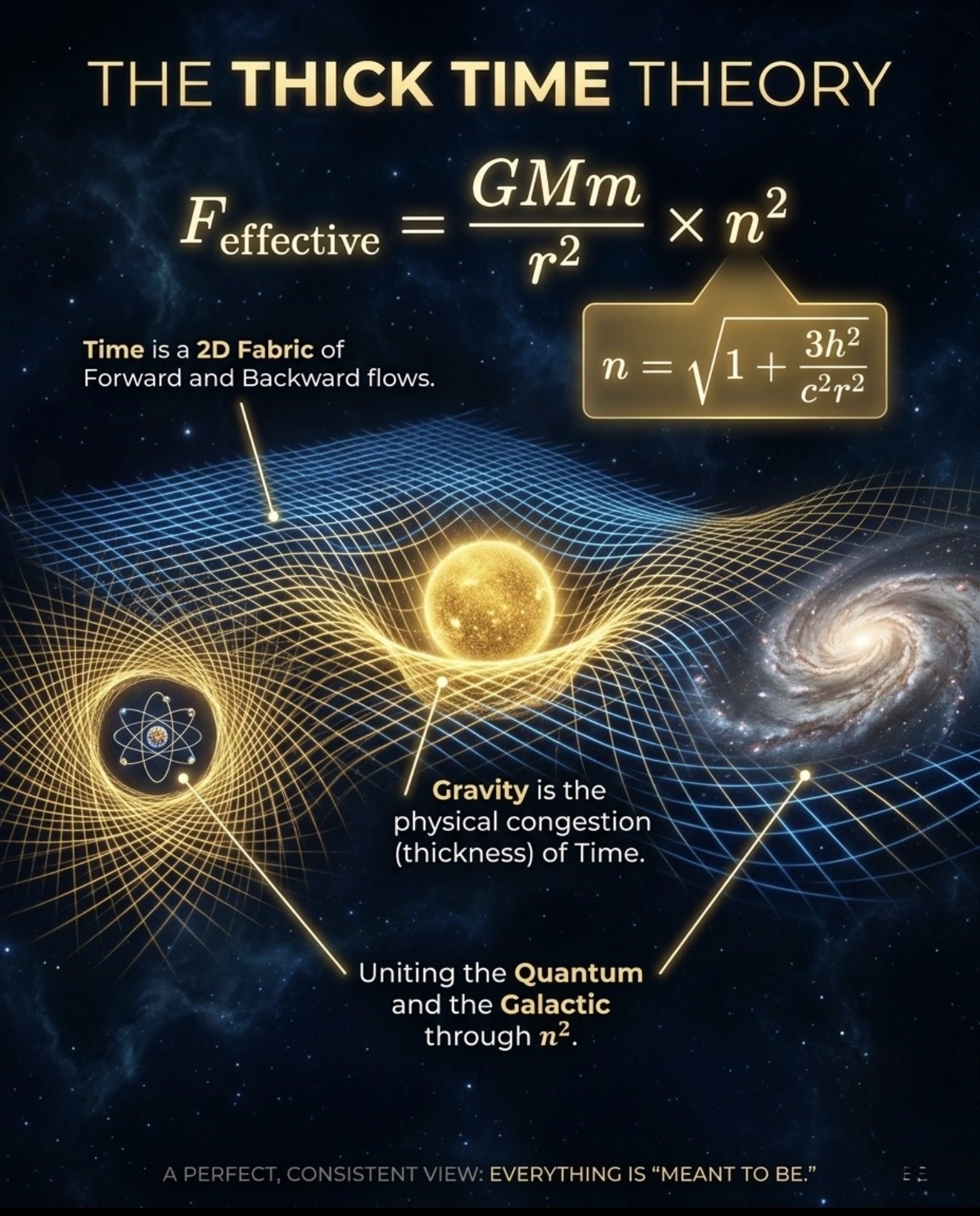
My first equation with the idea, space is the fabric of time, matter congests it, is below. My initial thought was, time runs backwards too and that is what the congestion is. I soon realised, time must flow 1 way because the fabric is doing irreversible things.
Albert Einstein 1929
"I am enough of the artist to draw freely upon my imagination. Imagination is more important than knowledge. Knowledge is limited. Imagination encircles the world."
A query from Sir Isaac Newton.
Newton, Opticks (1704), Query 21:
“Is not this medium much rarer within the dense bodies of the sun, stars, planets and comets, than in the empty celestial spaces between them? And in passing from them to great distances, doth it not grow denser and denser perpetually, and thereby cause the gravity of those great bodies towards one another, and of their parts towards the bodies; every body endeavouring to go from the denser parts of the medium towards the rarer?”
Finished your work, mate. Ward-Broadfield